

This post will ponder the following question:
Do we recognize naivety when we see it?
On a daily basis, we make the unconscious decision to defer to what we might call “professional experts”. These people are paid to know what they know because the majority of us have neither the time, nor the inclination, to do the research ourselves. This is a division of labour that most of us have tacitly accepted.
Indeed, we rarely call experienced professionals “naive”. They may be wrong once in a while but this is not due to naivety. What is the real cause? That is a question we rarely, if ever, ask ourselves. More often than not, we attribute it to random luck, even as we watch these people make the same mistakes, in the same exact way, over and over again.
Why did this team lose? They had the most experienced coach and a highly regarded general manager. They had a bunch of veteran players who “play the right way” and have a lot “character in the room”, but still, they finished well below expectations. How could this happen?
Was the team constructed poorly? Of course not. Everyone agreed at the start of the season that they had the right mix of “talent” and “character”.
Were they poorly coached? Impossible, their coach has tons of experience. He does things the right way.
It must be then, that the team just didn’t “gel”. This coach just couldn’t get the “buy-in” he needed from these players. This coach will win a championship, just not with this team. This team will also win, just not with this coach.
This is magical thinking.
Either the team did not have the right players, or they were poorly coached. Or both. Yet we continue to believe that a) this is a good team and b) this is a good coach. Everyone is doing things the way they’ve always been done. We trust the process because they trust the process.
Why do we do this? Because we fundamentally refuse to believe that these people could be naive. We tend to think of naivety as a sophomoric state to be overcome through experience and perspective. The naive, the thinking goes, are people who have not yet been disabused of their foolish preconceptions. In other words, the accumulation of relevant experience in one’s field is a guaranteed cure for naivety. But are things really that simple?
This sports example suggests that a lot of the everyday wisdom that we take as gospel is nothing more than an amalgamation of nebulous traditions and meaningless maxims cobbled together out of convenience. In sports, these conventions have their charm. Sure they might be slightly buffoonish, but that’s what makes sports so fun to watch. To truly experience sports on a deep level we have to temporarily suspend disbelief. This is something we accept going in.
So we are willing to accept that “experts” in the world of sports often merely perpetuate charming superstitions. But surely experts in more serious matters – let’s say political pundits – are more reliable.
***

In July of this year, Hillary Clinton officially secured the Democratic nomination for the 2016 Presidential election with 2,814 delegates to Bernie Sanders’s 1,893. In July 2016, this result seemed predictable and logical. In September of 2015, that result would have been deemed absurd.
Why does this matter? Because this dichotomy is revelatory of the type of prognostication we have come to expect from our political pundits.
In the fall of 2015, Bernie Sanders was a relatively unknown, self-described “socialist” Senator from Vermont. Hillary Clinton was the former First Lady, and Secretary of State, a prominent figurehead of the Democratic Party for the last 20 years.
O.K. you might say. But there must have been other factors. Things are never quite that simple.
Try telling that to the pundits.
All we heard at the time was: Hillary would win in a cakewalk. In fact, She would be wise to start strategizing for the general where she would be facing Jeb Bush. The fact is, virtually all the pundits were wrong on this one. Dead wrong.
How could this happen?
I think we can attribute this failure to two important developments in contemporary media. The first is the “live commentary” nature of the 24-hour news cycle. The second is insularity of the pundit community and the contemporary obsession with “access”.
***
Live Commentary Journalism
The “24-hour news cycle” has become somewhat of a catchphrase in recent years. Increasingly, it has been used as a shorthand for all that is wrong with mass media today. The reality is, however, that today’s non-stop news cycle has had very real, pernicious side effects. A good example of this is the rise of the “live-commentary” pundit.
Since news must now be on 24/7, the demands of the current news cycle have effectively outstripped the media’s ability to find, research and present legitimate news stories. Rather than reacting to and explaining events that have actually happened, political pundits have therefore taken to predicting what will happen in the future.
How can they possibly know these things you might ask?
They don’t. They have no idea.
What they could do is study evolving voter trends through advanced polling, or monitor the effects of demographic changes in major cities, or analyze the effect of stagnant wages among the middle class. But who has time for that? Instead, they guess. They guess because they do not have time to do otherwise. And so they make the assumption that was has happened will happen again. This is the equivalent of walking into a casino and taking the first bet on the house. Low risk, low reward. Even if they are wrong, no one can accuse you of making a bad bet.
Now, obviously, you would not be considered a good gambler in this scenario. To put it bluntly, if you only ever bet on the house, what the hell are you doing in a casino in the first place? A good gambler would take a calculated risk – based on knowledge and experience – in order to obtain a much greater reward. Political pundits do none of this. Why is this? Surely they must realize they are being naive.
The reason is, they believe they have insider information no one else has.
***
Inside the Beltway
When political pundits make their “bets” they are effectively relying on a collection of ideas and assumptions based, in large part, on anecdotal evidence. This is what we tend to call “conventional wisdom”.
The “house always wins” is a good example of this. Is it true? Of course not. But it sounds good. Kind of like “the establishment politician will win in a landslide”. We like this type of statement because it conveys a sense of blanket certainty. It sounds wise.
Political “insiders” often do seem wise to us, and that’s largely because they are portrayed as “grizzled veterans”, well versed in the back-room dealings and machinations of Washington, or London or Ottawa. They must know all there is to know about this kind of stuff. After all, they have access to the most powerful and influential politicians in the land.
Access. The word we all keep hearing. Journalists have always wanted access. They want access to the people, places and information they need to fill out a story. They need some insider info to fill in the blanks, to confirm speculation and turn it into a genuine news story. This is a basic necessity of the job.
Increasingly, however, access has begun to trump all else. In a 24-hour news landscape, long-form investigative reports are no longer appealing. What is appealing is a scintillating sound bite from a big name. Something to tease to the audience right before cutting to commercial. As a result, the traditional journalist has been replaced by the political insider.
Why is this a problem?
Let’s say, for example, that you are a health inspector. Except, instead of making regular, thorough inspections like you’re supposed to, you just kind of hang out in the restaurant instead. You wouldn’t call yourself an inspector, necessarily, as much as a “food health insider”.
Now let’s push this metaphor a little further. Let’s say that you don’t actually get paid for finding health violations. Instead, you get promoted for maintaining good relations with these restaurants. You can bet that if you report a health violation at a given restaurant and almost put them out of business, your relationship with said establishment will never really be the same. Needless to say, they won’t be in a hurry to bring you your regular. They’ll be on the guard around you – maybe they’ll actually improve their health standards to avoid getting caught again – but they certainly won’t be friendly with you. Begin to see the conflict here?
Now, obviously, health inspectors are not paid to maintain good relations with restaurants. This wouldn’t make any sense. After all, their very job is to keep them in line. Does this sound familiar?
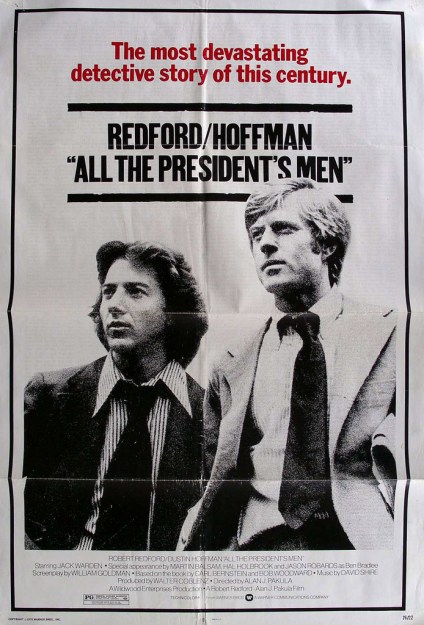
We all know that journalists are supposed to keep politicians honest. They are Dustin Hoffman and Robert Redford exposing the Nixon administration in All the President’s Men. This, we can all agree, is the journalistic ideal.
But do contemporary political insiders really do this? And more importantly, do we notice? Until fairly recently, media competition was for stories, not access. Journalists were working overtime in the newsroom, not tripping over each other on the way to the press briefing to sit through meaningless nonsense and political speak.
A lot of this has to do with technology. If the press briefing weren’t broadcast live who would really care about it? Would we really take the time to read predictable political talking points in the newspaper the next day? Doubtful. We pay attention because it’s on. If something is live, it requires our attention.
In this media landscape, politicians are no longer adversaries. They are cash cows. Unless a huge, spontaneous scandal erupts, political insiders have every reason to maintain a business-as-usual attitude when it comes to covering politicians. Go in, get your quote, get out. Get up the next day and do it again. They don’t bother to dig deep into their policies because there’s no reason to. Major networks operating on a profit margin do not require political reporting. They require political gossip.
The contemporary political insider, therefore, does not trade in tips or scoops but in experience. They do not work years on the job to bring us the live news as it appears. They appear on the live news to bring us their years on the job.
***
Let us return to the example of the 2016 Democratic Primary. The pundits did not get this one wrong because they failed to understand either of the candidates. Any veteran political correspondent would know Bernie Sanders and Hillary Clinton quite well from their combined 50-plus years of political experience. What the Beltway pundits failed to understand was the everyday American.
Because in this media environment, how on earth could we expect them to know how voters think? Who has time to think about the disaffected voter in rural Nebraska, or the recently-laid-off Rust Belt factory worker? Anthony Weiner just took another selfie.
Indeed, with such narrow-minded incentives, how could we expect our pundit class to make reasoned, nuanced prognostications about anything at all – never mind the outcome of a popular election?
Now that would be naïve. ♦
 The Ponderer