
In August 2011, Vladimir Putin emerged victorious from the depths of the Black Sea, holding two ancient Greek amphorae, one in each hand. With a sly grin, Putin stood on the beach before photographers, displaying the exceedingly rare artifacts, which he had supposedly fished from the sea just moments before.
More than a simple photo-op, this publicity stunt was in many ways, the crescendo of Putin’s manufactured, alpha male persona. In this moment, a hitherto jocular and lighthearted bravado became purely and sublimely ridiculous.
Was this the intended effect? You might say that Putin’s knowing grin, immortalized in the now widely publicized photos, tells us all we need to know. If we look closely, however, it tells us four crucial things:
He did not actually do this unbelievable thing.
We know he did not do this unbelievable thing.
He knows we know this.
None of this actually matters.
Indeed, two months later, Putin’s official spokesman openly admitted, on national television, that the whole event was a stunt. “Look – Putin didn’t find down there jugs that had lain there for many thousands of years. It’s obvious,” he said. “Of course they were found in the course of an expedition several weeks or days earlier. Of course they were left there or placed there. It’s completely normal.”
With this statement, the Russian government made explicit what had been true for years – the country was now run by a post-truth regime. By this I mean a regime that does not merely disseminate lies for political benefit, but lies gratuitously and blatantly in order to blur the very line between truth and fiction.
***
The common refrain in the West regarding Putin goes something like this: “Russians love strong men. They will put up with pretty much anything as long as they have an ostentatiously-alpha-male leader to admire.” This sentiment was most often heard when Putin appeared in a shirtless photo on horseback, or supposedly performed some kind of death-defying stunt. The idea of a flamboyantly narcissistic hardman seemed foreign to us, and more than a bit humorous.
Suddenly, for many in America at least, this concept does not seem so funny. Indeed, to some, it has become genuinely terrifying, while to others it seems, it has become the new normal. I am, of course, referring to the meteoric rise of Donald J. Trump.
I am not the first to compare Trump to Putin. Indeed, the association is often made to deride Trump for his supposed pro-Russian leanings:
Putin = Bad. Trump likes Putin. Therefore: Trump = Bad.
It seems to me, however, that it would be more useful to examine the common tactics that Trump and Putin have put to use, tactics that if employed effectively, can destroy all pretense of democratic accountability.
***
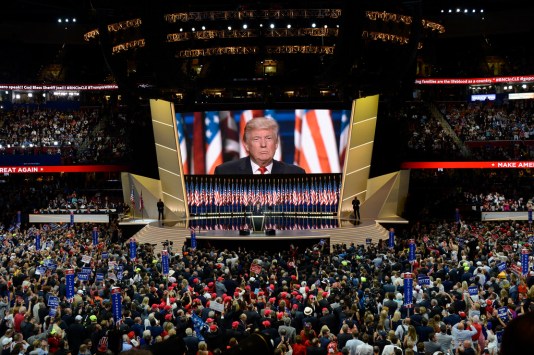
One of the more common criticisms of Donald Trump is that he would be “bad for our democracy”. While true, this statement, considered on its own, is a little vague. Sure, Trump has “authoritarian tendencies”, but in practice, he would be constrained by the U.S. Constitution. No matter what one may think of Trump, it is highly unlikely that he would turn the United States into a full-blown dictatorship.
The real danger Trump poses to American democracy is much more insidious. Throughout this campaign, Trump has effectively normalized the practice of the ostentatious lie. Trump lies so much, and so blatantly, that we cannot help but roll our eyes. As many debate fact-checkers will attest, the sheer frequency of his lies makes it virtually impossible to hold him to account on all of them.
When a normal person is caught in a lie, he or she will likely try to cover it up somehow. Lying, after all, is a shameful act; it reflects poorly on your character. Trump and his campaign managers do not share this concern.
What do they do when caught in a lie? They just keep lying. Trump will tell us he was being “sarcastic” or that he was telling some kind of joke. He does not even bother to delete old tweets when they directly contradict what he says on national TV. This is because he has crossed a threshold beyond truth and fiction. There is no true or false; there are no facts. To go back and cover up a lie, implies there is some kind of objective reality to which we must all adhere.
The subliminal message here is the following: “Do not pay attention to the details of what I am saying. It doesn’t matter that I constantly contradict myself. At the end of the day, I have your interests at heart. Anyone who criticizes me is not to be trusted, and even worse – they are after you and your way of life.”
Sound familiar?
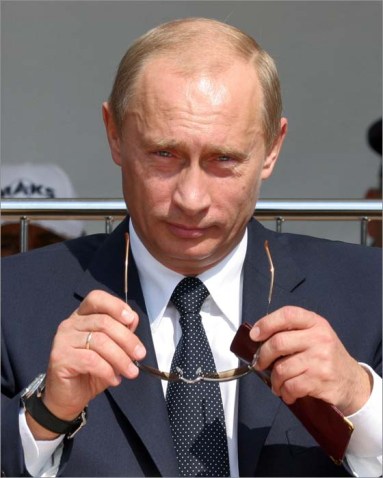
The obvious problem with this whole equation is that these politicians can no longer be held to account for what they say. They can say one thing and do another. It doesn’t matter. But what gives them the power to do this? Why are they not called out on their lies, and more importantly, why doesn’t it work when they are?
***
Parochial signaling
One of the crucial steps in establishing a post-truth polity is creating a mass-scale bunker mentality through what I call parochial signaling. The function of parochial signaling is two-fold:
First, it stakes a claim to its target audience by taking on a certain measure of political risk through incendiary language. This usually takes the form of “politically incorrect” or abrasive rhetoric against a politically relevant foe such as “Muslims” in Trump’s case or the “The West” in Putin’s. If this politician is willing to say these brazen things publicly, the logic goes, he must be on our side.
Second, it shields the politician in question from accusations of flip-flopping. Since the politician in question has already engaged in extreme parochial signalling – i.e. taking a strong, often controversial position against a feared “other” – any subsequent statements to the contrary will not be seen as a retraction, or a change in policy, but as a token acknowledgement that there are some things you cannot actually say out loud.
Perhaps the clearest example of this is Trump’s handling of KKK leader David Duke’s endorsement of his campaign. When asked to disavow Duke’s support, Trump repeatedly dodged the question, only to finally confirm his disavowal in a subsequent interview. While to most people Trump ultimately came off as cynically noncommittal, his message to Duke’s sympathizers was clear: I am on your side.
The end result? A near-total lack of accountability. Trump succeeded in saying one thing aloud for the mainstream audience while pantomiming a racially-charged subtext to a more radical one. What are his actual plans? Who knows. That’s exactly the point.
***
Strategic Overexposure
Another core component of the post-truth politician’s arsenal is what I call strategic overexposure. Ever wonder why Hillary Clinton is widely considered untrustworthy while Trump, who lies constantly, is often regarded as a truth-teller or “straight talker”? For many close observers of the campaign – especially those who support Clinton – this has proven to be a frustrating conundrum.
The key to unraveling this question is to change our vantage point. We should not be asking which candidate appears to be lying and which candidate appears to be telling the truth but instead, which one comes across as secretive and which one appears more forthcoming.
Because at the end of the day, we’re not actually concerned with being lied to. We might say, “I hate those lying politicians” but what we really mean is “I hate not being in on the secret”. This is perfectly legitimate. If the NSA is spying on us for example, we want to know about it. What we have to be aware of, though, is that we do not typically ask for straightforward honesty. Instead, we are asking for exposure.
If a politician tells us one thing and then the next day tells us another, this is considered normal. One of those statements was clearly a lie but heck, it’s what politicians do. However, if said politician were to tell us nothing at all, only for the truth came out weeks, months, years later, you could bet there would be a public outcry.
This takes us back to public perceptions of Hillary Clinton. While you could easily argue that she is no more untrustworthy than Trump, she has – rightly or wrongly – maintained a strictly guarded public persona and has campaign managers that will do anything in their power to keep certain things, be it as simple as a bout of pneumonia, out of the public eye. This is exactly what people do not like.
In contrast, the post-truth politician is always in the public eye. Whether it’s a shirtless photo-op in the Russian wilderness or an “all-caps” Twitter tirade at 2 A.M., they are constantly exposing themselves to us. This creates the impression that they are forthcoming, that they have nothing to hide. Never mind that nothing they reveal to us has any policy relevance, they are relating to us on a personal level.
When all is said and done, the post-truth politician’s actual words do not matter as much as the intimate connection that many of us feel with them. Who cares about accountability when you can get your most politically incorrect views validated and have a good laugh at the same time?
***
But what about those who don’t support anything Trump or Putin are actually saying? Surely they aren’t being duped?
To be sure, many of us will see post-truth politicians lie through their teeth and parade themselves in front of us 24/7, thinking, incredulously: how do they get away with this?
The truth is, our incredulity is all part of the plan. When these politicians act ridiculously – like staging a deep-sea archaeological discovery or saying crazy things on Twitter – we tend to shrug it off, because hell, if nothing else they are entertaining. We know it. They know it. That’s half the battle right there. Add in a media obsessed with maintaining “fairness” and “balance” at all times, and the habitual liar gets away with it every time.
Until recently, most Americans would have seen the latest Trump antic and dismissed it with a casual, there he goes again. A couple months later, Trump has proven that you can lie your way to the threshold of the presidency, if not all the way there. ♦
 The Ponderer