

The internet is changing journalism. Tell us something we don’t know.
We all know that Twitter has taken over the role traditionally occupied by newspapers and the evening news and that the phone has become the principal source of media consumption in the 21st century. Thanks to the recent American election, we also now know that Facebook is responsible for Fake News (O.K. maybe we don’t know that).
One thing we don’t tend to talk about, however, is how the internet has changed the way we relate to the news.
***

In the heyday of television news, families would gather in living rooms across the nation to hear, by and large, the same newscast. On the television would be a newscaster, looking directly at the camera, reading off of a teleprompter. The communication was fundamentally one-sided. The newsman read you the news, end of story. Discussions on the day’s events occurred afterward, in these same living rooms, once the telecast was over.
Today, families rarely gather around the television set. Instead, each family member receives the news alone from his or her personalized telephone or tablet. No need for family discussions to make sense of the news. Discussions now occur in real time, with strangers, in online comment sections that often devolve into a flurry of anonymous vitriol.
Sounds like a grim picture doesn’t it?
And yet, thanks to the internet, the average person on the street today has access to more information than any person in history. Sure, the internet may be isolating at times, but it is also making us smarter, more curious and more aware of the world around us.
Our news media should reflect that.
***
From Infotainment to Infowars
The most common reaction among the news media to our world of constant connection has been to entertain. Indeed, there is so much entertainment available to us these days that 24-hr news networks have concluded that the only way to retain our attention is to constantly enhance the spectacle.
News titles flash across the screen. Cat videos are intermixed with war footage from Syria. Anything to keep us from looking away. And yet there’s a reason why CNN is the go-to television channel in airports: It has become background noise, sights and sounds to mildly distract while waiting for one’s flight.
How’s this for a news flash: people don’t want to be entertained by the news. They can get their entertainment in a million other places. What people actually want, deep down, is to be informed and to feel empowered by that information.
Take the whole “Fake News” phenomenon. Thousands of people turned their attention away from glossy CNN coverage to focus on $2 goddaddy.com websites. How do you explain that?
One of the main reasons these websites are so successful is that they claim to offer people the straight goods: no talking heads, no reality show celebrities, just the real news that “Big Media” doesn’t want you to hear. Nevermind that these websites play into the most base human instincts, often peddling wild fabrications. Warped as their “facts” may be, these sites promise their readers a form of empowerment through knowledge. People jumped at the opportunity.
Go figure.
***
Breaking the Fourth Wall
Of course, the majority of people are not clamouring for right-wing conspiracy theories. The simple reality is that we now consume media on a purely one-to-one basis. We want transparent interlocutors, not talking heads. While major news networks continue to operate on the old model, up-and-coming news outlets, mainly online, are beginning to challenge them for viewers.
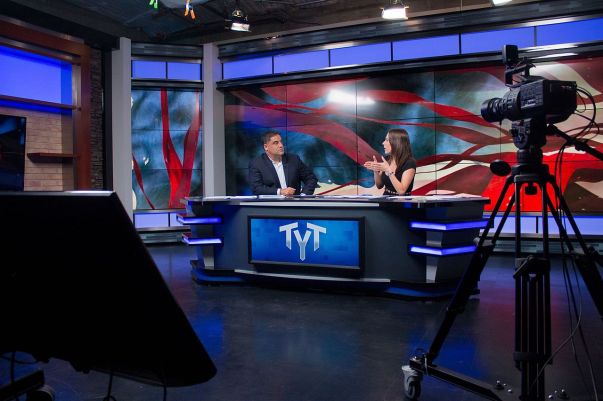
The Young Turks, or TYT, a broad YouTube network of progressive news shows, breaks all the rules of the traditional newscast. It talks to its viewers and breaks down the fourth wall between presenters and audience. The hosts adopt a conversational tone, often reading real-time viewer twitter responses on air. Today, TYT’s online viewership exceeds that of CNN and The New York Times.
We have access to endless amounts of undiluted data at our fingertips, rendering, the old-fashioned model of sitting back and having the news dictated to us obsolete. By comparison, the traditional newscast appears rigid and anachronistic, its pre-packaged clips pedantic and contrived.
As we turn on the evening news — usually after an exhausting day of digesting vast amounts of contradictory and confusing information about the world — a little voice goes off inside our heads: Who are these people in perfectly tailored suits, speaking expertly-composed sentences, and why are they pretending that everything is normal? Amidst the informational chaos of the digital age, the staid decorum of the newscast anchor is more disingenuous than dignified.
Charlie Brooker’s Wipe series expertly taps into this feeling. The host, part-comedian, part-journalist, part-social-commentator, never attempts to simplify what is happening. If anything, he accentuates the confusing and convoluted nature of world events. What he is saying essentially is: “yeah all this stuff going on is pretty f***** up isn’t it? You’re not crazy, I see it too.”
You might say that the internet has transformed us all into obnoxious, gifted students who scoff at the professor’s seemingly dumbed-down lessons. Never mind that gifted students don’t actually know everything; they simply tune out of the usual lesson — they can’t help it. And neither can we. ♦
 The Ponderer